
By Nicolay B. Johansen, LovUrett
Moreta Bobokhidze, ModusA, 3 minutes reading time
Georgia: Anton Chechin, a 26-year-old political activist, was detained in December 2024 and sentenced to 8 years in prison earlier this month. This is by all standards a purely political decision, although it was made in the courtroom. This is typical for autocratic societies. People should be aware of how the penal law makes this possible.
Political activists in Georgia are routinely charged with possession of drugs. Are political activists disproportionately prone to drug use? Could it be that drug use confuses their minds and affects their activism? Or are government agencies using drug regulations as a means to suppress political opposition? Recent developments support the latter. The case with Anton Chechin may serve as an illustration.
2024 marked a significant turning point in Georgian history. This was the year the ruling party turned to Russia as its ally, implemented a new law that criminalized so-called foreign involvement, and won the election through massive fraud. The Georgian public reacted with protests that have been going on ever since. Chechin, among many other protesters, including two other Russian citizens, faced charges of illegally purchasing and possessing a large quantity of narcotics, an offense punishable by eight years to life in prison.
Before moving to Georgia, Chechin was active in anti-Putin protests in Russia and supported opposition leader Alexei Navalny. He also joined demonstrations against Russia’s full-scale invasion of Ukraine. In 2024, the European Court of Human Rights ruled in his favor over his 2021 arrest at a pro-Navalny rally, finding Russia in violation of his rights and ordering compensation. Amid the intensifying crackdown on dissent, he relocated to Georgia in spring 2022. According to his lawyer, Chechin volunteered to help displaced Ukrainians once in Tbilisi and joined local protests, first in May 2024 against the reintroduction of the foreign agents’ law and again in November and December.
Chechin pleaded innocent to the charges, and his defense argued that the police planted the drugs on him because of his activism. On September 2., Chechin was sentenced to eight years and six months after being found guilty on serious drug charges. This verdict was the 15th jail verdict among those arrested in the context of the pro-EU, anti-Georgian Dream protests since last November.
Chechin’s case was among six similar drug-related arrests, with all suspects detained in December at the height of pro-EU protests. All defendants pleaded not guilty, claiming police had planted the drugs. They linked their arrests to their activism, citing the lack of video evidence of personal searches and the absence of neutral witnesses.
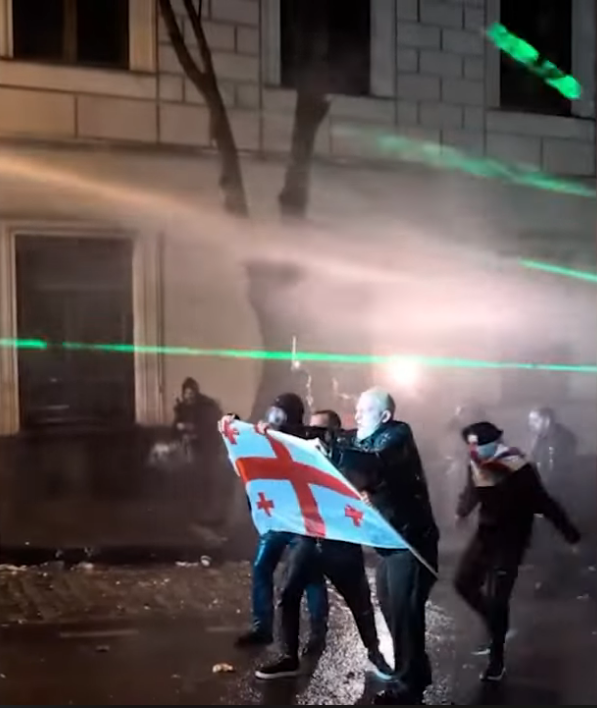
This is a recognizable pattern of selective law enforcement, weak evidence, and permissive courts. Here we will comment on the role of policing.
It is highly improbable that political activists should be more involved with the drug market than other citizens. However, it fits with the narrative already famously used in Russian media, that political opponents are “drug addicts” and the like. However, this does not explain 1) why the police so eagerly pursue drug offences amid political unrest, and 2) how drug offences so readily stick to the accused individuals.
The latter problem is related to the idea that drug problems are a public hazard. Facing public hazards, states are allowed to sidestep ordinary limits to governance, commonly included in constitutions and the rules of law. The whole world experienced this in the days of the COVID-19 pandemic. But the dynamic was, and is, in operation in drug policies in the Nordic countries. However, we will not pursue this side of the matter here.
Seen from the vantage point of the rule of law, the first problem can be answered by reference to the dynamics of criminalization in democratic societies. When a category of acts is included in the penal code, an opening is created for the police to go after these acts. This dynamic is described in this note on the essence of penalization. The police authorities have a certain degree of discretion in how they interpret these acts and how highly they prioritize pursuing them.
In Norway, the former chief of police in Oslo, Hans Sverre Sjøvold, provides an illuminating example. He once commented that he was satisfied with the prohibition of drinking in public places. Some voices claimed that it causes no harm when students enjoy parties in parks. The chief of police responded that police officers themselves know when the law should be applied and when it should not. He sent a calming message that the police would not stop students from having a party in the parks, but insisted that his colleagues needed this opportunity to put a stop to drunkards. He argued that the police need this “tool” and that the public should trust that they used their discretion in a way that conformed with their interests.
When any form of drug possession is criminalized, it creates similar opportunities for authorities. As long as the police serve as loyal agents of the government, they are likely to take advantage of this. Several factors support this dynamic, and we have observed it in both democratic and autocratic societies. In this way, the expectation of catching criminals so prominent in police forces is also fulfilled. Hunting down drug users has become a widespread activity within police forces worldwide.
Today, it is widely recognized that former U.S. President Richard Nixon deliberately used drug law enforcement to suppress political opposition. This serves as a warning about the dangers of penalization, especially regarding drug use. The public cannot fully trust the police to make decisions in our best interest. Penalization gives law enforcement a tool to target political opponents. Including drugs in the penal code makes this activity seem legitimate, even when it is not. We don’t need Georgia to see this, but the frontline in the fight against dictatorship makes the contrasts with democracy more evident.