
By Moreta Bobokhidze, 7 minute read
Norewgian version here
For more than a year, Tbilisi has lived in a state of constant civic unrest, with demonstrations unfolding daily across the city. What began in late 2024 as a spontaneous response to allegations of electoral fraud, democratic backsliding, and the government’s decision to halt progress toward European Union integration has evolved into a defining political struggle in Georgia. Reports throughout 2025 describe how police repeatedly used water cannons, pepper spray, and mass arrests during demonstrations, particularly around municipal elections, where the ruling Georgian Dream party tightened its grip amid boycotts from major opposition blocs. Tens of thousands regularly filled Tbilisi’s streets to voice dissatisfaction with what many viewed as a systematic erosion of democratic norms and an intentional drift toward Moscow’s influence, as reflected in protests where demonstrators carried EU flags alongside Georgian ones.
Even amid intense confrontations, the protests did not subside. Daily demonstrations continued across the capital: student marches, courthouse vigils, civil disobedience actions, and spontaneous gatherings outside government buildings. Government crackdowns escalated through 2025, including restrictive laws targeting NGOs and media, expanded surveillance, and the detention of activists measures widely described as part of an increasingly authoritarian turn by the state. International observers and rights groups noted these developments with growing alarm, documenting excessive use of force and politically motivated charges against protesters.
After more than a year of relentless mobilization, exhaustion became a tangible challenge. Protests that occur everyday demand extraordinary stamina from organizers, volunteers, and ordinary citizens who constantly risk arrest, harassment, or injury. Yet rather than diminishing the movement, this pressure prompted a strategic evolution. Daily gatherings continued, but the role of Saturday demonstrations grew increasingly central. By late 2025 and into early 2026, these weekend protests emerged as the primary focal point of mass mobilization, serving as a stabilizing rhythm for a population engaged in long‑term political struggle.
Saturday protests had already shown their power earlier in the movement. These Saturday rallies became moments when opposition leaders, activists, students, civil society members, and ordinary citizens could unify around shared demands, articulate grievances in a highly visible forum, and project the movement’s strength to both domestic leaders and the global community. Heavy police responses documented during Saturday rallies in 2025 including the use of water cannons and riot control force underscored how seriously the government viewed these mass gatherings.
The shift to large‑scale Saturday mobilization was therefore not a retreat from everyday activism but a deliberate tactical refinement. First, it helped counter the strain of constant protest participation by allowing citizens to conserve energy for peak weekly demonstrations while still maintaining daily resistance. Second, weekend scheduling ensured higher turnout; people with work or family responsibilities could participate more easily, transforming Saturdays into powerful weekly rituals of civic engagement. Third, major Saturday protests proved particularly effective at attracting international media attention. Outlets such as AP News, Euronews, CBC, RFE/RL, and Al Jazeera consistently covered major weekend events, amplifying Georgia’s democratic struggle on the global stage.
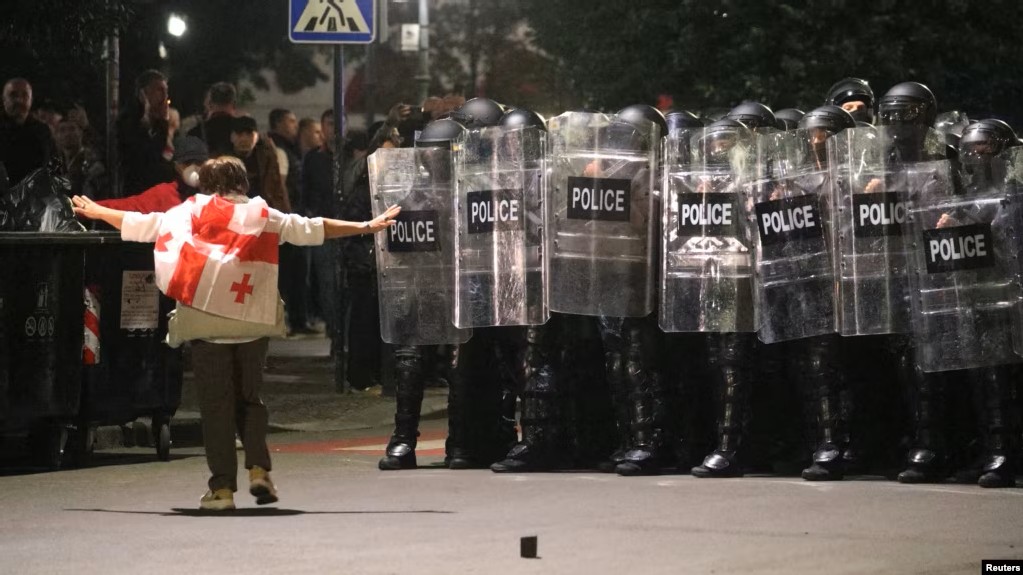
Meanwhile, the government continued to characterize large-scale opposition gatherings as threats to public order. In several high‑profile cases, officials accused protest leaders of attempting to overthrow the government, detaining key figures and opening investigations into alleged efforts to “violently alter Georgia’s constitutional order.” Such charges were condemned by activists and rights groups, who argued that the government was criminalizing dissent to suppress a legitimate democratic movement. The tone of state messaging a mixture of defiance, warning, and justification further deepened public distrust and fueled participation in the protests.
Despite the rising prominence of Saturday demonstrations, Tbilisi’s streets remained active throughout the week. Daily protests, though smaller, are still a central component of the movement’s identity and persistence. Students maintain university-based activism, civil society groups stage regular courthouse and parliament‑adjacent gatherings, and neighborhood-level protests appear whenever government actions trigger immediate public reaction. This dual structure daily demonstrations maintaining pressure and weekly mass gatherings amplifying it has allowed the protest movement to remain resilient and adaptive rather than fading under government scrutiny and fatigue.
The new rhythm of protest has arguably strengthened the movement. Saturday demonstrations offer the emotional cohesion and symbolic power that comes from seeing tens of thousands united in a shared vision. Daily protests, meanwhile, reinforce the message that discontent is not event‑based but constant and structural. Together they create a continuous presence, making it impossible for the government to claim that dissent is isolated, sporadic, or fading.
As Georgia moves deeper into political crisis, the protest movement’s evolution demonstrates its determination to endure. The public’s commitment to democratic principles, transparent elections, and a European future continues to animate both large and small demonstrations. The tactical shift toward Saturday mass mobilizations combined with sustained everyday resistance points to a maturing movement that has learned from experience, adapted for longevity, and found new ways to assert collective will even under pressure.
In Tbilisi, the protests are no longer merely reactions to isolated events, they have become a defining feature of civic life. Every day brings evidence of resistance, and every Saturday brings a renewal of collective strength. Georgia’s protest movement has entered a new phase one shaped by strategy, resilience, and the unwavering insistence that the country’s political future must be determined not by suppression, but by the will of its people.