By Moreta Bobokhidze, 4 minutes reading time
Hungary’s 2026 election felt like a political earthquake across Europe, but for me, watching it as a Georgian, it carried an even deeper resonance. When Viktor Orbán’s sixteen‑year rule came to an end, it was not just a Hungarian story, it was a reminder that even the most entrenched systems can shift when people decide they have had enough. The result was described as a rejection of democratic backsliding, corruption, and the suffocating sense of inevitability that often surrounds long‑standing ruling parties. But for those of us in Georgia, where Georgian Dream has governed for thirteen years and where elections await us in exactly three, the Hungarian outcome felt like a mirror held up to our own political reality.
Many observers have long noted the ideological and rhetorical parallels between Viktor Orbán and Georgian Prime Minister Irakli Kobakhidze. European media have repeatedly highlighted how both leaders have leaned into narratives about sovereignty, “traditional values,” and resistance to Western partners. Both governments have used similar language when criticizing civil society, independent media, and international organizations. For years, Orbán was one of the few EU leaders whose worldview aligned with Georgian Dream’s increasingly illiberal messaging. Seeing him lose power so decisively inevitably raises questions about what this means for Georgia’s political trajectory?
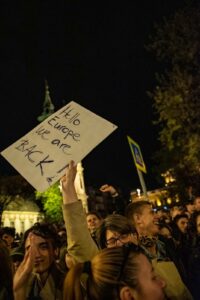
What struck me most about Hungary’s election was not just the result, but the atmosphere around it. Despite Orbán’s control over institutions and the media, Hungarian voters turned out in extraordinary numbers. One phrase kept echoing in my mind: “History is written by those who show up.” And the Hungarian people showed up—defying predictions, defying fear, and defying the belief that nothing could change. It was a reminder that democratic systems, even when weakened, still contain the seeds of renewal. And it was a reminder that people, when pushed far enough, reclaim their agency.
For Georgia, this is not an abstract lesson. Our political landscape has been shaped by a decade of polarization, democratic backsliding, and growing distance from our European aspirations. Georgian Dream’s political messaging increasingly resembles the communication style associated with Orbán’s Hungary, skepticism toward Western partners, attacks on civil society, and a narrative of “external interference” used to justify internal consolidation of power. The Hungarian election showed that such strategies can lose their effectiveness when citizens feel their future is being taken from them.
There is also a symbolic dimension that is hard to ignore. Orbán governed for sixteen years. Georgian Dream has governed for thirteen. In three years, Georgia will face its next parliamentary elections. The parallel is not perfect—no two countries share identical political dynamics—but the timeline invites reflection. Experts in Europe have already begun drawing comparisons, suggesting that Hungary’s experience demonstrates that long‑standing ruling parties are not immune to public accountability, even when they have reshaped institutions to their advantage.
For me, the Hungarian result also highlighted something more emotional: the fragility of hope and the power of collective action. In Georgia, many people feel exhausted by political stagnation, disillusioned by broken promises, and fearful of further democratic erosion. Yet Hungary’s election showed that change can come suddenly, even when it seems impossible. It showed that political longevity is not destiny. And it showed that societies can reclaim their direction when they refuse to accept the narrative that nothing better is possible.
The fall of Orbán also carries geopolitical implications. His defeat weakens one of the key illiberal voices within the EU one that often provided political cover for governments drifting away from democratic norms. For Georgia, this means that the European environment is shifting. The EU’s expectations for candidate countries may become clearer and firmer. The space for illiberal experimentation may narrow. And the contrast between Georgia’s public desire for Europe and the government’s increasingly anti‑Western rhetoric may become even more visible.
As I watched the news unfold, I felt a mix of relief, curiosity, and a quiet sense of urgency. Hungary’s election was not about Georgia, but it spoke to us. It reminded us that political change is not a miracle! It is a process shaped by public pressure, civic resilience, and the refusal to surrender to cynicism. It reminded us that even systems that seem immovable can shift. And it reminded us that the next three years in Georgia will matter profoundly. In the words of a Robert F. Kennedy “The future is not a gift, it is an achievement.” Hungary has shown that democratic renewal is possible. Whether Georgia will follow that path depends on us, on our courage, our persistence, and our belief that our country deserves better than resignation. The lesson from Budapest is simple: nothing is inevitable, not even the permanence of those who claim they cannot be replaced.
Also by Moreta Bobokhidze:
https://www.modusa.no/russia-did-it-9-april-1989-and-the-long-punishment-of-a-free-nation/
Democratic Backsliding in Georgia: An Analytical Overview of 2025
And much more on the pages of ModusA.no