By Moreta Bobokhidze
Reading time: 4 minutes
Two years ago today, on 28 November 2024, I remember exactly where I was when Irakli Kobakhidze announced the suspension of Georgia’s EU integration process.
For many outside Georgia, it may have sounded like another political statement.
For me, it felt like grief.
I grew up in a country where the European future was never simply about membership in the European Union. It was about dignity, democracy, rule of law, and the hope that future generations of Georgians would live in a country where freedom was protected rather than feared.
On that day, millions of Georgians realised that the path they had believed in for decades was suddenly moving in the opposite direction.
The protests started almost immediately.
Thousands of people took to the streets carrying Georgian and European flags. We were met with water cannons in winter temperatures, tear gas, mass arrests, and violence. Journalists, students, activists, and ordinary citizens being beaten, including deliberate blows to the face. Human rights organisations documented allegations of torture and other forms of ill-treatment in detention.
The two years that followed have been among the darkest in Georgia’s modern democratic history.
The foreign influence law was adopted despite months of peaceful protests and criticism from Georgia’s European partners. Civil society organisations and independent media became targets of political attacks and stigmatisation. Subsequent legislation further increased pressure on organisations and individuals cooperating with international partners. References to gender were removed from policy and legislative frameworks. Democratic institutions weakened, political prisoners remained behind bars, and Georgia’s European integration process stalled.
Many of the people who dedicated their lives to building a democratic Georgia have left the country.
I am one of them.
Leaving Georgia was never part of my plan. Like thousands of others, I carried my grief, frustration, and hope across borders. But leaving did not mean giving up.
My fight did not end when I left Georgia.
It simply took a different form.
Today, my work continues through advocacy, public speaking, writing, coalition-building, and reminding international audiences that behind every political headline are real people whose lives have been profoundly affected by the choices of those in power.
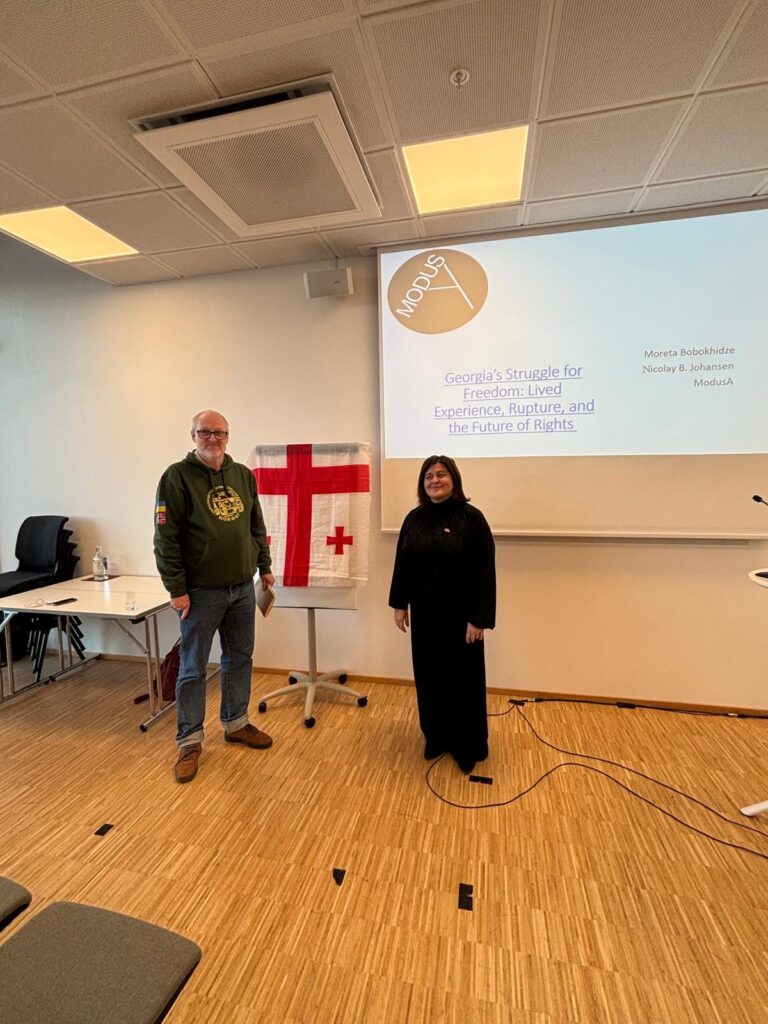
That is why yesterday’s panel discussion at MR-Dagarna carried special meaning for me.
It is not just another professional engagement.
It is a symbol of this continuing struggle.
I have dedicated the discussion to the second anniversary of the protests and to my fellow Georgians who remain on the ground, carrying the burden of resistance every single day.
To the students who continue to protest.
To the journalists who continue to report.
To the activists and human rights defenders who continue to organise despite growing risks.
To every citizen who refuses to accept fear as the new normal.
While many of us may now be separated by borders, we remain united by the same belief:
That Georgia deserves democracy!
That Georgia deserves freedom!
That Georgia deserves a European future!
Today, another large demonstration will take place in Tbilisi.
And although I will not stand among the crowd physically, my heart will be there.
Because distance does not weaken belonging…
Because exile does not erase responsibility…
Because hope survives even when institutions fail…
I am Georgian!
I am European!
And I refuse to believe that the future of my country belongs to authoritarianism, repression, or the politics of fear.
One day, Georgia will return to the democratic and European path chosen by its people.
Until then, we continue.
For those who can no longer speak.
For those who remain imprisoned.
For those who were forced to leave.
And for those who are standing in the streets of Tbilisi today, carrying the hope of an entire nation!