By Moreta Bobokhidze, 5 minutes reading time
On 17 June 2026, the European Parliament issued its strongest response to Georgia in decades, voting with overwhelming support to impose targeted sanctions on officials deemed responsible for dismantling democratic institutions, constraining civil society, and deepening political alignment with Russia. The resolution marked a decisive shift in the EU’s posture: for the first time, Brussels declared that it does not recognize the legitimacy of Georgia’s current parliament or the president it appointed. For a country whose population has consistently demonstrated pro‑European aspirations, this was not merely a diplomatic reprimand; it was a clear indication that Georgia’s political leadership had moved outside the boundaries of what the EU considers compatible with democratic norms.
The EU’s concerns were grounded in specific findings. Investigators identified the Kulevi oil terminal on Georgia’s Black Sea coast as a logistical node for Russian oil shipments, facilitated through opaque ownership structures and high‑risk maritime practices. Its inclusion in the EU’s 20th sanctions package the first time the EU has sanctioned infrastructure located in a candidate country underscored the seriousness of the issue. This was not a symbolic gesture. It signaled that Georgia’s government had crossed a threshold that directly challenged the credibility of the EU’s sanctions regime and raised broader questions about the country’s geopolitical orientation.
Days later, Amnesty International released Anatomy of Repression – Georgia: 500 Days of Protest, Crackdown and Resilience, a comprehensive assessment of the human rights situation. The report documented one of the most significant erosions of civil liberties in Georgia’s post‑Soviet history: thousands of peaceful protesters arbitrarily detained or fined, hundreds subjected to torture or ill‑treatment, and more than 150 individuals imprisoned following unfair or politically motivated trials. Amnesty described a coordinated system in which the ruling party deploys disinformation, smear campaigns, and restrictive legislation to suppress dissent and weaken independent oversight.
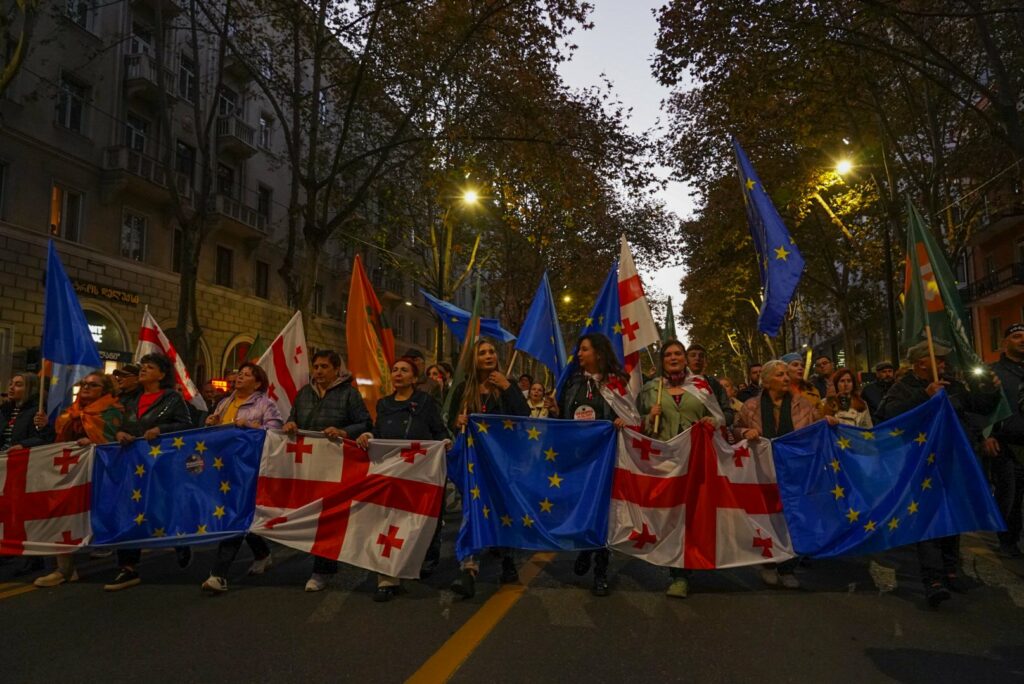
Central to this system are the 2024 “foreign influence” law and the 2025 “foreign agents” act, which impose intrusive monitoring, mandatory registration, and the threat of asset freezes or imprisonment on NGOs and media outlets. Amnesty further documented the use of excessive force by police, deployment of less‑lethal weapons in ways that caused serious injury, and the involvement of proxy groups in attacks on demonstrators. The judiciary, according to the report, has been instrumentalized to validate politically motivated prosecutions and limit public scrutiny. Amnesty’s conclusion is unequivocal: peaceful dissent in Georgia has been effectively criminalized, and state institutions have been repurposed to consolidate political control.
For international observers, these developments may appear consistent with global patterns of democratic backsliding. But for Georgians, the consequences are immediate and personal. Students, journalists, civil society organizations and ordinary citizens face intimidation, legal pressure, and physical violence. Families wait outside police stations for detained relatives. Older generations recognize echoes of earlier authoritarian periods. The erosion of rights is not theoretical; it is experienced daily.
The EU’s sanctions matter because they demonstrate that democratic regression carries consequences, even for countries pursuing EU integration. Amnesty’s report matters because it provides detailed evidence of how rapidly institutions can be captured and freedoms dismantled. And Georgia matters because its civil society continues to demonstrate remarkable resilience. For more than 500 days, citizens have mobilized to defend democratic principles and the country’s European trajectory, often at significant personal risk.
Georgia now stands at a critical juncture. If current trends persist, the country risks further EU and US sanctions, potential suspension of visa‑free travel, reduced financial assistance, and increasing political isolation. An alternative path remains possible, but it requires reversing the current trajectory and restoring institutional checks and balances. The international community has taken note of the actions of the Georgian government; it is equally important to recognize the determination of Georgian citizens who continue to advocate for democratic governance. The future of the country will be shaped not only by external pressure but by the persistence of those who continue to defend their rights and freedoms.
More reports and comments by Moreta Bobokhidze: https://www.modusa.no/category/english/