By Nicolay B. Johansen and Moreta Bobokhidze
A 5 minute read. A Norwegian version is published on Filter Nyheter and elsewhere in these webpages
A democratic front line runs along the entire old belt between Russia and Europe. The front line move back and forth in countries such as Poland, Hungary, Serbia, Moldova, Bulgaria, and Slovakia. In Ukraine there is full-scale war, but the struggle is also intense elsewhere, such as in Georgia and the South Caucasus. The Baltic states and Romania seem lost to them, but Scandinavia and the West are subject to the same pressure. To see the democratic front line as a whole, it may be wise to broaden the view from the battlefields in Ukraine.
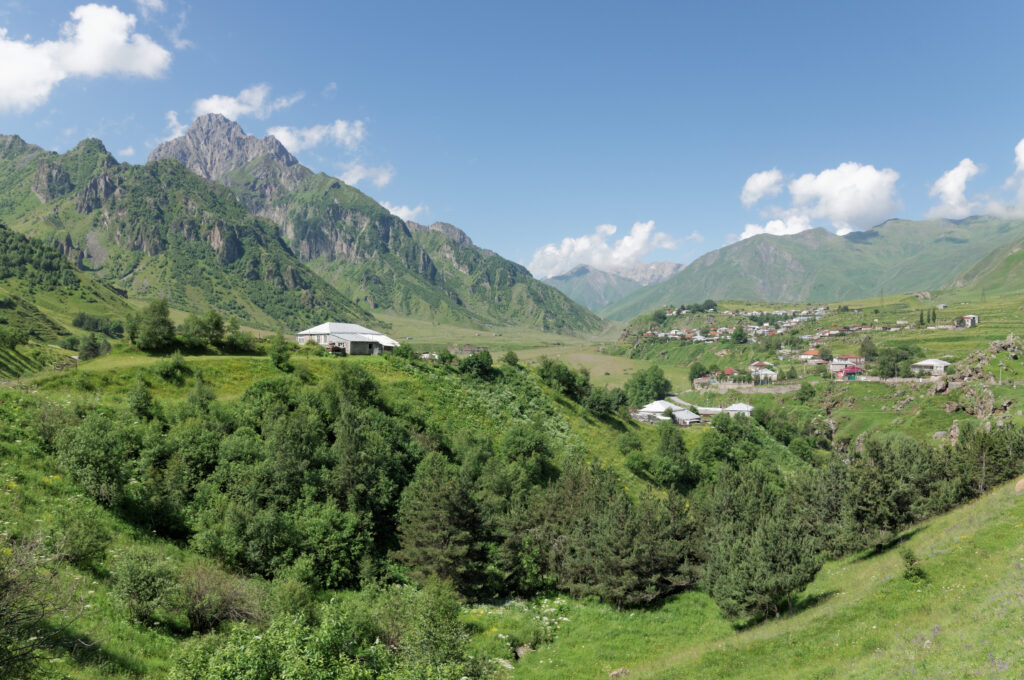
In a long series of articles, ModusA has reported on the struggles for democracy in Georgia. Georgia is a country that, in many ways, resembles Norway: a fairly small country by population, with many mountains and a border with Russia. However, they have only had 35 years to find their way, while we in Norway spent 70 years achieving parliamentarism and 200 years securing judicial review in the constitution. Their conditions are also far more difficult.
Georgia was a Soviet republic until the Soviet Union’s collapse in 1991, and in its early years, it struggled to build democracy. The longing for Europe was stronger in Georgia than in its close neighbors, Azerbaijan and Armenia, but Russia kept a watchful eye on developments. They occupied Abkhazia in 1992, and in 2008, the so-called South Ossetia. Both invasions came under the pretext of saving Russian-speaking minorities. This is a pattern all former Soviet republics recognize. They know that what follows such “concerns”, are very real military interventions and occupations.
Today, an authoritarian former colonial power stands on the other side of the belt of former Soviet republics, and Russia’s leadership still has ambitions to dominate its former republics. They try to maintain their grip through a wide range of tools: from economically favorable energy supply agreements, sabotage, threats, political influence, and election interference to occupation carried out with brutality we in the West regard as “medieval”. They quite literally reduce the cities they occupy to rubble and treat both their own and others’ soldiers with no regard for international conventions on warfare.
It is easy to become fixated on the medieval nature of warfare. Anyone who wants to see the full picture must take a step back to gain a proper impression of the breadth of Russia’s assault on democracies. Georgia is well-suited as such a fixed point.
Georgia’s path towards democracy and the rule of law has progressed in fits and starts. Presidents have been elected, and corruption has caught up with them. Again and again, voters have looked for new leaders who could build institutions capable of keeping democracy in place according to European and Western models. This was also true of the Georgian Dream party, which won the 2012 election. However, it was overtaken by Russian pressure behind the scenes. The Russians had already occupied two large territories, and we do not know what was said before 2024, but then Georgian Dream changed course. Like Yanukovych in Ukraine in 2014, they turned against their own population and strengthened ties with Russia. And they retained power after massive electoral fraud.
This was more than 500 days ago now, and Georgians have been protesting outside government buildings ever since. They have been beaten, fined, punished, and imprisoned, but they are still there, every single day. At the same time, Georgian Dream has followed the playbook known from other countries in the belt of post-Soviet states: they undermine civil society, bring the media into line, ensure that the courts are not independent, take direct control of the police and administration, and show great ingenuity in introducing new rules that prevent critical voices from taking part in elections.
All of this can be followed almost minute by minute in the reports from Georgia, written by the democracy advocate Moreta Bobokhidze on ModusA’s website.
– Georgian authorities are taking a heavy-handed approach toward demonstrators.
– Demonstrators are punished for arbitrary offences without the courts intervening.
– This makes women particularly vulnerable.
– The authorities are restricting access to voting.
– At the same time, the human rights situation continues to deteriorate.
– Civil society is being crippled.
John Færseth writes that massive electoral fraud has now become a tradition, including threats and rewards for “correct” voting, monitoring of voting, organized double voting, and the outright production of fake votes.
However, one need not have any particular interest in Georgia to see what is significant in these reports. They are also reminders of how democracy and the rule of law function here at home. It is easy to forget that civil society is important for the same reasons here as in the rest of the West. In turn, this is a reminder that what happens in voluntary organizations, such as Norwegian People’s Aid, matters. They were recently infiltrated by Russian interests. We see the same thing on social media, where Russian interests are massively present, with fake accounts and automated messages targeted at spreading their talking points. The strategy is clear: rather than claiming that Russia is a good country, they claim that Western societies are hypocritical, corrupt, and “no better”. The courts are not independent, and politicians think only of themselves.
Norway, like our Nordic neighbors, is constantly exposed to sabotage and provocations from the east, but this happens in secret, and for a long time, we have imagined that it might be coincidences, giving Russian citizens the benefit of the doubt when they have pursued their curious drone hobbies around Norwegian airports and military installations. Much suggests that Russian interests are strongly present in English governance and public affairs, where they have also placed enormous financial assets. Opposition politician Nigel Farage was behind the Brexit movement and is now doing well in opinion polls with messages that Russian interests have cultivated for years. He has received large sums from the Russian side. Much like the wealthy Saakashvili in Georgia and Yanukovych in Ukraine before Maidan and the Revolution of Dignity.
There are no guarantees that Norway will be spared from Russia’s “foreign policy”. The front line includes Norway. A Ukrainian scenario is not realistic right now, but what is happening in Georgia is far more relevant than the distance would suggest.