What Kavelashvili’s Trip to Tehran Reveals About the Country’s Political Soul
By Moreta Bobokhidze, 4 minutes reading
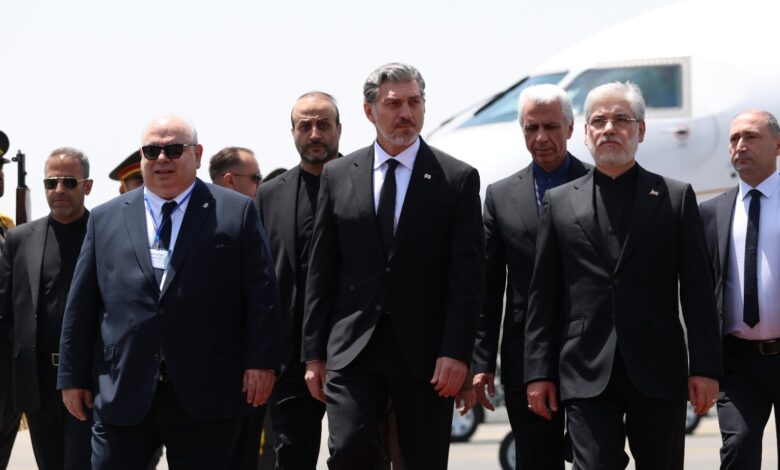
Last week, Georgian President Mikheil Kavelashvili stood among world leaders in Tehran, paying tribute at the funeral of Iran’s former Supreme Leader Ayatollah Ali Khamenei, a man widely described as a dictator, responsible for decades of repression and regional destabilisation. Kavelashvili attended the ceremony, met Iranian President Masoud Pezeshkian, and spoke of “peace, stability, and good‑neighborly relations” between Georgia and Iran.
On the very same day, the bodies of Georgian fighters who died defending Ukraine were brought home to Tbilisi. Their families stood at the airport in grief and silence. No senior Georgian government official appeared to honor them. Two scenes.
Two forms of mourning. Two messages to the world. And together, they tell a painful story about where Georgia stands today.
Kavelashvili’s trip was not an isolated gesture. Georgian officials have repeatedly expressed condolences to Iran during the war, and the government has signaled interest in expanding ties with Tehran in trade, culture, and science. But attending the funeral of a leader responsible for systemic human rights abuses sends a different kind of message. It places Georgia among a group of states Tajikistan, Turkmenistan, Iraq, Uzbekistan whose attendance reflected geopolitical alignment rather than democratic values.
For a country that once branded itself the “beacon of democracy in the region,” this choice raises uncomfortable questions: Why does Georgia repeatedly appear at ceremonies honoring authoritarian leaders? What does it signal to Western partners who already question Tbilisi’s democratic trajectory? Whose values does the Georgian state represent today, its people’s or its ruling party’s?
As Kavelashvili paid respects to Khamenei, Georgian volunteers who died fighting Russia in Ukraine were returned to their homeland. These men fought in a war that most Georgians see as existential a struggle against the same imperial force that occupies 20% of Georgia’s territory.
The absence of government officials at the airport in Tbilisi was not accidental. Georgian Dream has long avoided public recognition of Georgian volunteers fighting in Ukraine, framing them as individuals acting on their own rather than representatives of the Georgian nation. This stance reflects the government’s cautious, often ambiguous posture toward Russia, and its desire to avoid gestures that might provoke the Kremlin. Yet the volunteers who died in Ukraine were fighting against the same imperial force that occupies 20 percent of Georgia’s territory. Their sacrifice resonates deeply with Georgian society, which overwhelmingly supports Ukraine and sees its struggle as intertwined with Georgia’s own. The government’s silence therefore feels not only political but moral. It suggests a reluctance to honor those who embody the values of resistance, freedom, and solidarity that Georgia once proudly championed.
The connection between these two events is not coincidental. They reveal the priorities of a government that mourns strategically. By choosing to honor a foreign autocrat while ignoring Georgian citizens who died defending democratic ideals, the state communicates what and whom it values. Mourning becomes a political act, a declaration of alignment. Georgia’s leadership chose to mourn a dictator whose ideology contradicts the country’s democratic aspirations, and chose not to mourn Georgian heroes whose sacrifice aligns with the values Georgia claims to uphold. This contrast exposes a widening gap between the Georgian people and the Georgian state. Most Georgians remain strongly pro‑European, pro‑Ukrainian, and committed to democratic principles. But the government’s actions increasingly reflect the opposite.
What does this say to the world? It says that Georgia’s official posture is no longer reliably democratic. It says that the government is comfortable standing with authoritarian leaders while distancing itself from democratic struggles. It says that Georgia’s geopolitical identity is shifting, not because its people have changed, but because its leadership has chosen a different path. And what does it say about where Georgia stands today? It says that the country is at a crossroads not only politically, but morally. The government’s choices reveal a retreat from democratic identity, a willingness to align with illiberal states, and a discomfort with honoring those who resist Russian aggression. Yet the people who welcomed the fallen soldiers home have not changed. Their commitment to Europe, to Ukraine, and to freedom remains strong.
Georgia’s divided mourning is a mirror. It reflects the tension between the values of its citizens and the priorities of its government. It shows a nation whose heart still beats for democracy, even as its leadership signals otherwise. And it raises a question that grows louder with each such moment: who speaks for Georgia today its government, or its people?