
By Moreta Bobokhidze. Reading time, 4 minutes.
When Irakli Kobakhidze appeared on Euronews to discuss Georgia’s European future at a conference in Brussels, viewers might have expected answers. What they received instead was a masterclass in contemporary political evasion: a performance built on grievance, inversion, and the increasingly familiar strategy of treating reality as an optional accessory.
“What he demonstrated instead was a communication style increasingly familiar from Moscow and Mar-a-Lago: never concede, never correct, never explain, and above all, never let facts interrupt the story.”
For nearly forty minutes, the Georgian Prime Minister insisted that his government remains committed to European integration. Yet what emerged from the interview was not a roadmap to Europe but a catalogue of excuses explaining why everyone else is responsible for Georgia’s isolation except the government that engineered it.
The central paradox of Kobakhidze’s message is almost comical.
According to him, Georgia remains passionately devoted to EU membership. At the same time, Brussels is supposedly guilty of «blackmail»; European institutions are allegedly biased; the European Commission’s assessments are dismissed as politically motivated; and laws criticised by the EU, the Venice Commission, and democratic watchdogs are portrayed as perfectly European.
One is left with an obvious question: if everyone in Europe is wrong and only Georgian Dream is right, what exactly is left of the European project that the government claims to admire?
This rhetorical method is not uniquely Georgian. It belongs to a broader political tradition associated most visibly with Vladimir Putin and Donald Trump: never admit error, attack the referee, and transform accountability into victimhood.
The comparison is not about ideology. It is about technique.
When confronted with criticism, Putin rarely argues that criticism is valid but should be balanced with other considerations. Instead, critics become agents of hostile interests. Likewise, Trump developed a political style in which every investigation became a conspiracy, every institution became corrupt, and every unfavourable fact became «fake news.» The objective is not necessarily to convince audiences that the leader is right. The goal is to convince them that objective truth no longer exists. If everything is propaganda, then nothing is propaganda. If everyone lies, nobody can be held accountable. This is the oxygen of modern authoritarian politics.
Kobakhidze’s Euronews appearance followed an eerily similar script. Asked why Georgia’s EU path has stalled, he did not acknowledge concerns repeatedly raised by European institutions regarding democratic backsliding, judicial independence, media freedom, or legislation targeting civil society. Instead, responsibility was transferred entirely onto Brussels. The problem, viewers were told, is not the government’s actions. The problem is Europe’s reaction to those actions.
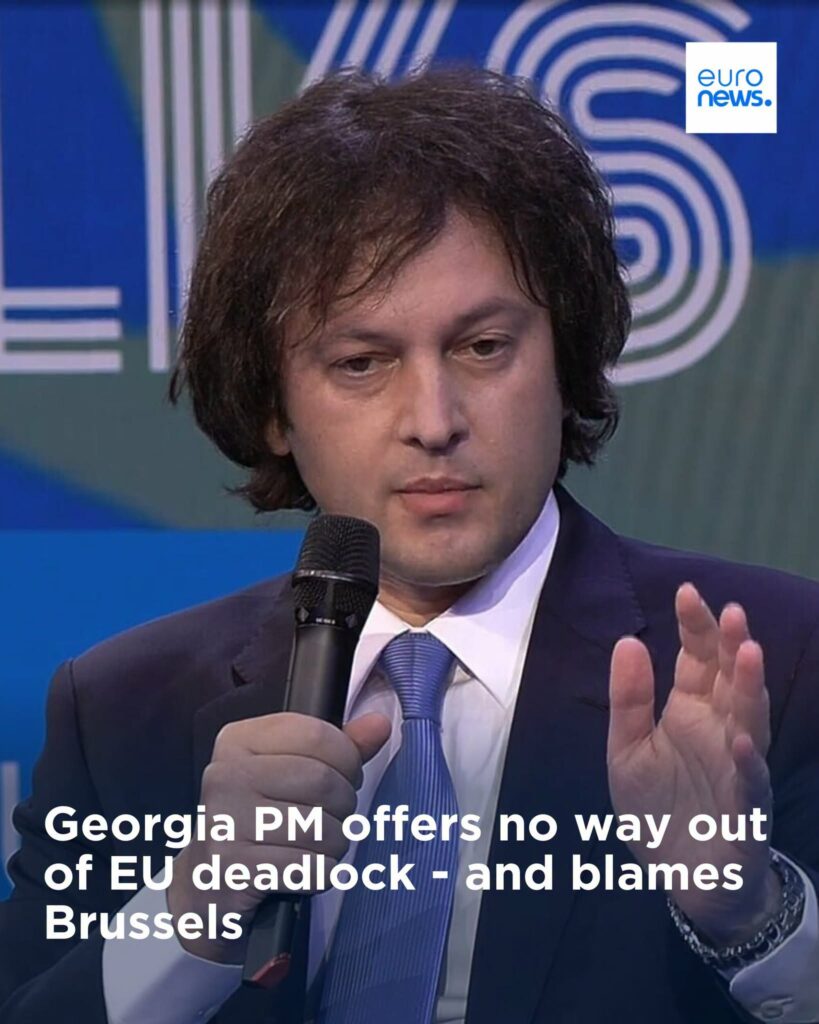
It is a remarkable argument. If accession is frozen because Brussels objects to specific laws, a government genuinely prioritising membership would seek compromise. Kobakhidze offered none. Euronews noted that while declaring himself «very committed» to EU membership, he refused to consider reversing the controversial measures that have become key obstacles in relations with the EU.
This is rather like insisting you desperately want to board a train while simultaneously refusing to go to the station.
Perhaps the most striking aspect of the interview was the inversion of cause and effect. European institutions argue that democratic standards have deteriorated. Kobakhidze argues that criticism itself is evidence of European misconduct. European officials identify concerns regarding governance. He describes this as «blackmail.» European bodies issue legal assessments. He dismisses them as political.
In this framework, every criticism validates the government’s narrative. Every concern becomes proof of bias. Every obstacle becomes someone else’s fault. It is politically useful. It is also intellectually empty.
The tragedy is that Georgia’s European aspiration is real. Public support for EU membership has remained overwhelmingly strong. The country did not move towards Europe because Brussels forced it to. Georgians demanded it. We marched for it. We voted for it. We built a national consensus around it.
Yet in Brussels, Kobakhidze appeared less interested in explaining how Georgia would move closer to Europe than in explaining why Europe should lower its standards for Georgia. That is not a strategy. It is a negotiation tactic borrowed from leaders who have spent years redefining reality whenever reality becomes inconvenient.
The danger is not simply that such rhetoric misleads international audiences. The greater danger is that it encourages citizens to lose faith in the very idea that facts matter. Once politics becomes a contest between competing fantasies, accountability evaporates. Power survives not by performance but by narrative control.
And that, perhaps, was the most revealing aspect of the Euronews interview.
The Prime Minister came to Brussels claiming to defend Georgia’s European future. What he demonstrated instead was a communication style increasingly familiar from Moscow and Mar-a-Lago: never concede, never correct, never explain, and above all, never let facts interrupt the story.