
By Moreta Bobokhidze, reading time 4 minutes.
It has taken decades to build a scaffold of checks and balances in the penitentiary system. Only a few years was needed to dismantle it. The result is violence, as in the case of Giorgi Davitadze. Let us start with the uncomfortable truth: a Georgian man alleges he was raped by uniformed officers, and the nation reacts with a shrug. This silence is the result of fourteen years of deliberate dismantling of every safeguard that once stood between the prisoner and the state. Giorgi Davitadze’s case is the inevitable outcome of a system that has been stripped of knowledge, oversight, and courage. I know this, because I saw the system collapse myself.
The collapse began in 2018, when the Penitentiary and Probation Training Center was abolished and merged into the Justice Training Center under Minister of Justice Tea Tsulukiani. That decision killed the only institution where prison staff were taught international standards, human rights obligations, and modern correctional philosophy. I delivered training for prison and probation staff on international standards for the treatment of prisoners, on torture prevention, harm‑reduction principles, and the essential role of rehabilitation programs. I often drew on the work of Norwegian criminologist Nils Christie, echoing his enduring critique that prisons frequently create more suffering than they resolve.
The Center was built entirely with EU financial support. It had a mock cell, training rooms, a library, accommodation facilities, and a diverse pool of national and international trainers. It was a symbol of Georgia’s European aspirations. And Georgian Dream quietly dismantled it.
Then came 2018, when the Ministry of Corrections was abolished. Prisons were absorbed into the Ministry of Justice where they became easier to control and harder to monitor.
By 2019, when I became an independent expert of the National Preventive Mechanism, the system was already hollow. COVID‑19 accelerated the decay. Prison visits became rare. Rehabilitation programs ended. NGOs were pushed out. The Ombudsman’s office weakened. The Special Prevention Mechanism once active, principled, and present grew quiet.
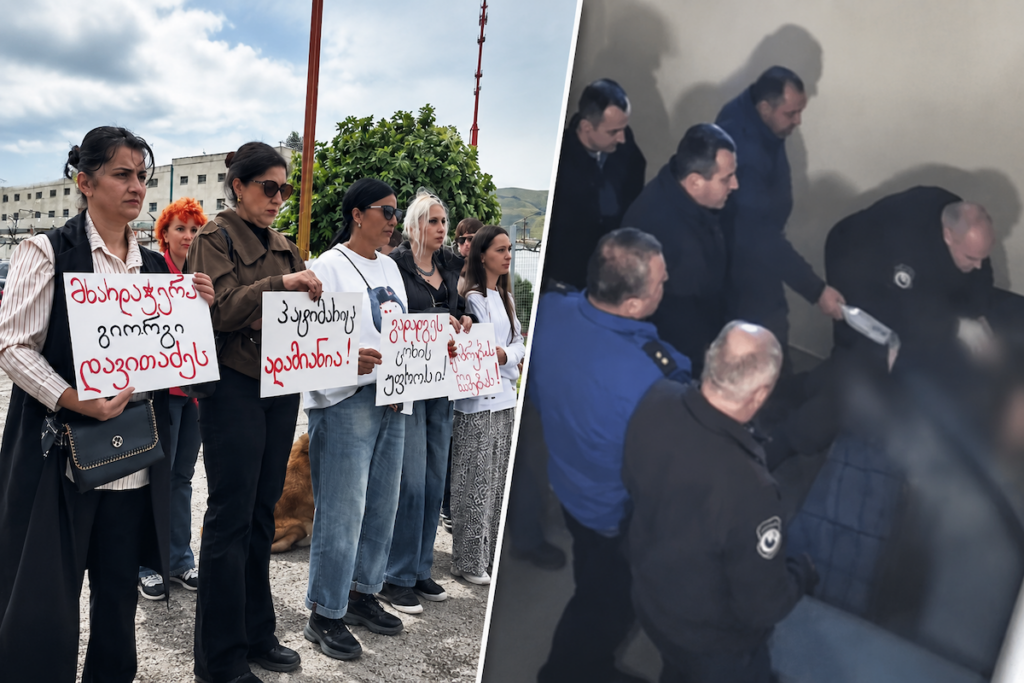
No Ombudsman, No NGOs, No Outrage: Empty Human Rights Architecture
And today I must ask, loudly and without apology: Ombudsman, where are you? Special Prevention Mechanism, where are you? Why are you silent?
When an inmate alleges rape, silence is complicity. Cautious statements are not enough. Procedural language is not enough. A few visits and a press release are not enough. The institutions designed to prevent torture must speak with force, urgency, and independence!
This silence is the result of a political environment where oversight bodies are pressured, underfunded, and discouraged from confronting systemic abuse. And it is precisely why the government wanted NGOs out of prisons.
Georgian public, do you now understand why Georgian Dream worked so hard to vanish NGOs? Because when civil society is removed, there is no one left to say a word.
This is the environment in which Giorgi Davitadze was allegedly raped. And after fourteen years of systemic decay, I am not surprised.
Violence in Georgian prisons is not an exception; it is a legacy. It is rooted in Soviet gulags, in the “thief‑in‑law” hierarchy, in the normalization of humiliation as discipline. No government neither before nor after 2012 has managed to truly reform the correctional system. The 2012 scandal was supposed to be a turning point, but instead it became a historical footnote.
What has changed most painfully is society. In 2012, videos of torture triggered mass protests and contributed to a government’s downfall. Today, allegations of rape against a Georgian man barely stir public outrage. The silence is chilling. What happened to the dignity of the Georgian man? Has propaganda succeeded so thoroughly that sexual violence against a prisoner is now tolerated, even accepted?
I have no doubt that uniformed men sexually harassed Davitadze. Violence has become normalized in Georgian law enforcement structures. I experienced it myself just one year ago, when a policeman kicked me down a staircase during a peaceful protest.
The root causes are painfully clear: a polarized, scared society where institutions are hollow, propaganda is constant, and fear is cultivated. A society where masculinity is weaponized politically but abandoned morally. A society where the state’s denial of torture has lasted more than a decade, and where the Penitentiary Department continues to insist that nothing is wrong.
I still hope for a real investigation, though hope feels increasingly futile. And I feel profound shame that the Penitentiary Department has spent more than ten years denying the obvious: that torture and sexual violence never disappeared-they were simply pushed out of sight, waiting for the next Davitadze to remind us of the truth.
Unless accountability returns, unless professional training is restored, unless external monitoring is revived, and unless society remembers that dignity is not optional, the next case will come. And the next. And the next….
So, I end with the words of Nelson Mandela, which today feel painfully precise for Georgia: “It is said that no one truly knows a nation until one has been inside its jails. A nation should not be judged by how it treats its highest citizens, but its lowest ones.”